Why China’s TCL Is Slowly Pulling Back From Its India Business | Markets Today (image source: Chat GPT "AI Generated Visuals")
Our Daily Dose of Truth and Trends
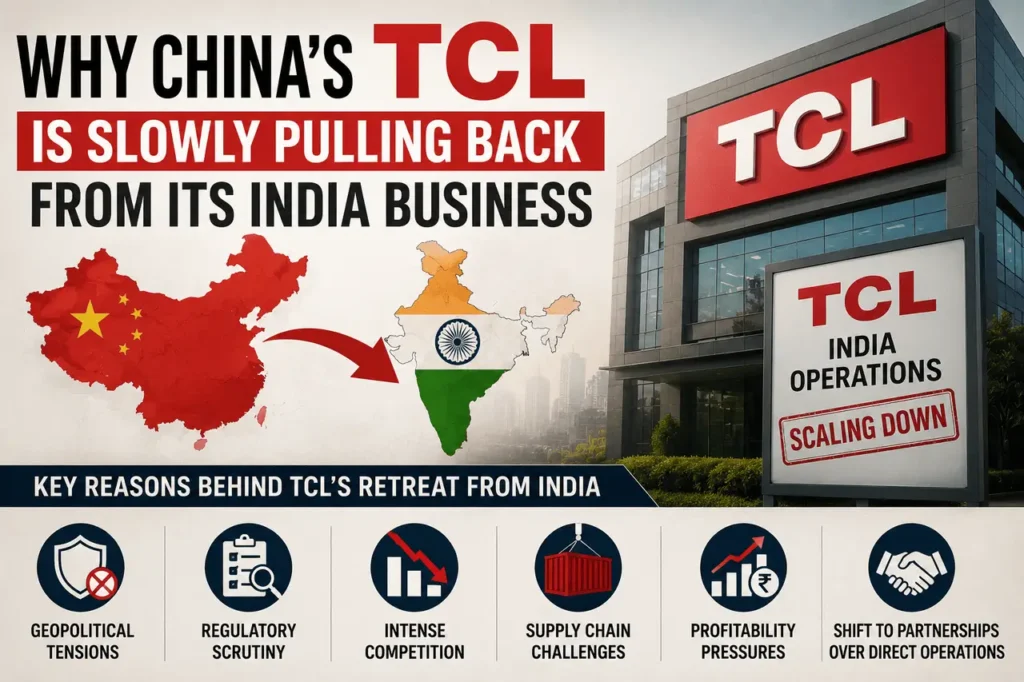
Why China’s TCL Is Slowly Pulling Back From Its India Business | Markets Today (image source: Chat GPT "AI Generated Visuals")
TCL, one of China’s biggest electronics companies, appears to be gradually stepping away from its business operations in India. The company, known globally for its smart TVs, home appliances, and display technology, has seen its presence in the Indian market weaken over the past few years, raising questions about what led to this shift.
India was once considered a major growth market for TCL. With rising demand for affordable smart televisions and home electronics, the company entered the country with ambitious plans to compete against brands like Samsung, LG, and Xiaomi. Its aggressive pricing strategy initially helped the brand gain visibility among Indian consumers.
However, things began to change as geopolitical tensions between India and China intensified after the 2020 border clashes. Since then, several Chinese companies operating in India have come under increased regulatory scrutiny. Government restrictions, compliance checks, and tighter investment rules created a more challenging environment for Chinese businesses.
Industry experts believe these developments significantly affected TCL’s long-term plans in the country. Reports suggest that the company has reduced its direct operational focus and scaled back expansion activities in India, choosing instead to operate more cautiously through partnerships and distribution channels.
Another major challenge has been intense competition in India’s electronics market. The smart TV segment, in particular, has become crowded with brands offering similar products at highly competitive prices. Companies like OnePlus, Sony, and several emerging Indian brands have increased pressure on foreign manufacturers trying to maintain market share.
Supply chain disruptions and changing import policies have also played a role. Many electronics companies dependent on Chinese manufacturing have faced delays, higher costs, and logistical hurdles in recent years. For TCL, maintaining profitability while dealing with these issues may have become increasingly difficult.
Despite the slowdown, TCL has not completely exited India. Its products are still available through online platforms and retail channels, but the company’s visibility and marketing presence have noticeably declined compared to earlier years.
Analysts say this reflects a broader shift happening among some Chinese firms operating in India. Instead of making aggressive investments, several companies are now adopting a low-profile strategy to avoid regulatory complications and market uncertainty.
At the same time, India remains one of the world’s fastest-growing consumer electronics markets. This means companies like TCL may still see long-term potential here, even if they are temporarily reducing their direct involvement.
For Indian consumers, the immediate impact may not be significant. TCL products are expected to remain available for now, although future product launches, service expansion, and local investments could slow down if the company continues to scale back operations.
The situation also highlights how global politics and business are becoming increasingly interconnected. Decisions made at the diplomatic level can directly influence corporate strategies, investments, and market presence across countries.
In the end, TCL’s gradual retreat from India appears to be driven by a combination of regulatory pressure, rising competition, geopolitical tensions, and shifting business priorities. Whether the company makes a stronger comeback in the future will largely depend on how India-China business relations evolve in the coming years.