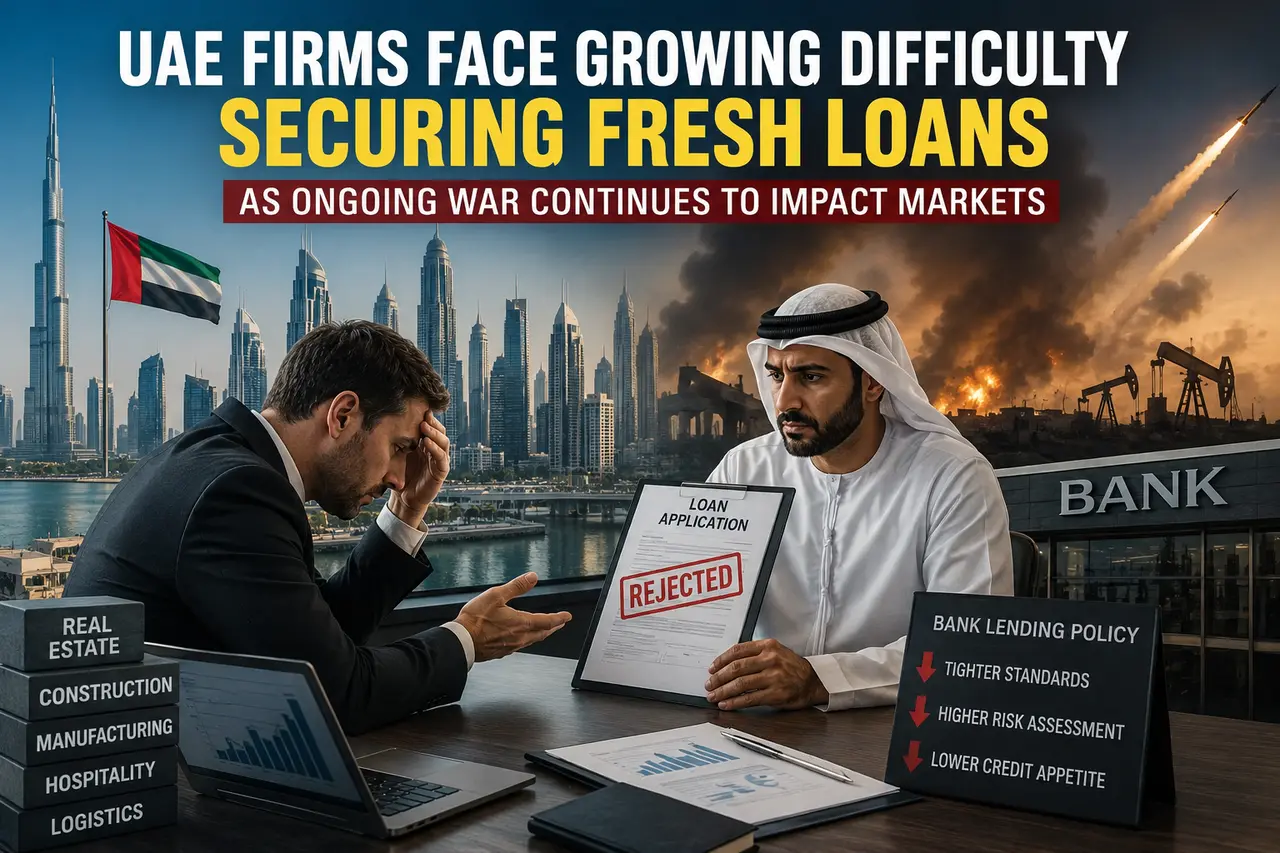
UAE Firms Face Growing Difficulty Securing Fresh Loans as Ongoing War Continues to Impact Markets (image Sorce: "Chat GPT "AI Generated Visuals")

Our Daily Dose of Truth and Trends
UAE Firms Face Growing Difficulty Securing Fresh Loans as Ongoing War Continues to Impact Markets (image Sorce: "Chat GPT "AI Generated Visuals")

In Dubai, banks are reportedly becoming more cautious with lending as the Iran conflict continues into its third month, creating growing uncertainty across regional markets.
According to industry executives, while existing loans and ongoing projects have largely remained stable, obtaining fresh credit has become increasingly difficult for businesses. Financial institutions are now tightening lending conditions and applying stricter approval standards before issuing new loans.
Sectors such as real estate, construction, manufacturing, hospitality, and logistics are said to be facing the biggest challenges, as banks grow more concerned about rising risks linked to the prolonged geopolitical tensions. Business leaders say lenders are carefully reassessing exposure before committing to new financing.
Businesses across the United Arab Emirates are reportedly finding it increasingly difficult to secure fresh loans as regional tensions and the ongoing conflict involving Iran continue to create uncertainty in financial markets. Industry experts say banks are becoming more cautious while evaluating new lending proposals, particularly in sectors exposed to economic fluctuations.
According to banking executives and market analysts, lenders in the UAE are tightening credit approval standards amid fears that prolonged geopolitical instability could affect investments, trade activity, and overall business confidence. While existing loans and projects are largely continuing without disruption, companies seeking new financing are reportedly facing stricter scrutiny.
Sectors such as real estate, construction, hospitality, logistics, and manufacturing are among the most affected. Businesses operating in these industries often depend heavily on bank financing for expansion, infrastructure, and operational expenses. However, with uncertainty rising, financial institutions are now prioritising lower-risk lending strategies.
Industry insiders say banks are carefully reviewing repayment capacity, project viability, and long-term market stability before approving fresh loans. Some companies have reportedly experienced delays in loan processing, while others are being asked to provide stronger collateral or additional financial guarantees.
Economic experts believe the cautious approach is largely driven by fears that the prolonged conflict could impact oil prices, investor confidence, regional trade routes, and tourism activity. Although the UAE economy has shown resilience in recent years, global investors and lenders remain sensitive to instability in the Middle East.
Despite these challenges, analysts note that the UAE banking sector itself remains relatively stable and well-capitalised. Financial institutions are not stopping lending completely, but they are becoming more selective in order to protect themselves from potential future risks linked to economic volatility.
Business owners, meanwhile, are urging authorities and banks to maintain balanced lending policies so that growth sectors are not severely impacted. Many firms fear that restricted access to financing could slow down expansion plans, hiring, and investment activity across the country.
Experts also point out that companies with strong financial records and lower debt exposure are likely to continue receiving support more easily than businesses already facing cash flow pressure. Firms are now being encouraged to strengthen financial planning and reduce unnecessary liabilities during uncertain times.
The situation highlights how geopolitical conflicts can indirectly influence economies far beyond the immediate war zone. Even countries with stable banking systems and strong infrastructure, like the UAE, can experience ripple effects through reduced investor confidence and tighter financial conditions.
For now, businesses across the UAE are closely monitoring regional developments while adapting to a more cautious financial environment. Many hope that improving geopolitical stability in the coming months could ease pressure on markets and encourage banks to gradually resume more aggressive lending activity.