India Unveils 7 New Bullet Train Corridors (image source: "Chat GPT AI Generated Visuals")
Our Daily Dose of Truth and Trends
India Unveils 7 New Bullet Train Corridors (image source: "Chat GPT AI Generated Visuals")
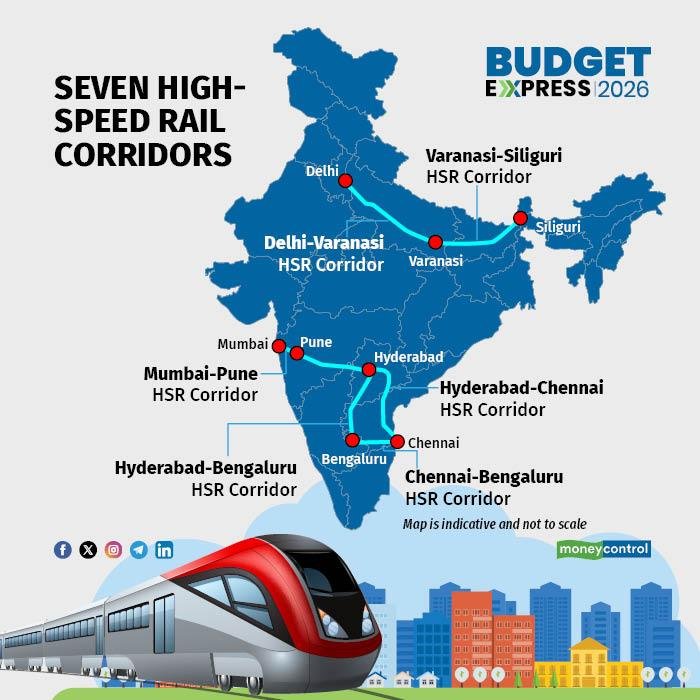
India’s high-speed rail plans have received a significant boost with the approval of seven new bullet train corridors aimed at drastically reducing travel time between some of the country’s major cities. This proposed network is expected to strengthen business connectivity across various regions, improve mobility, and modernize long-distance transportation.
This announcement builds upon the progress of India’s first high-speed rail project—connecting Mumbai and Ahmedabad—which is currently under construction. This new expansion is part of a major national plan to create a future-ready transportation system based on high-speed rail technology.
One of the most notable routes is the proposed Mumbai-Pune bullet train corridor, which could reduce travel time to just 48 minutes. Currently, this journey often takes several hours, depending on traffic and the mode of transport. This proposed corridor could significantly transform daily commuting and travel within the region.
Another key corridor is the Bengaluru-Chennai route, where travel time is estimated to drop to approximately 73 minutes. As both cities are major hubs for technology, industry, and business, this route is expected to facilitate the movement of professionals and boost economic activity between the two regions.
Government officials have indicated that these corridors are part of a long-term strategy, and processes such as detailed feasibility studies, funding models, land acquisition, environmental clearances, and final route alignment will be completed before construction begins. No final launch date has been announced for these new corridors yet.
Officials also stated that India is moving towards establishing domestic design standards for high-speed rail infrastructure, which includes bridges, stations, tunnels, and elevated structures. The objective of this initiative is to enhance standardization and reduce long-term reliance on imported specifications.
Proponents of this scheme believe that bullet trains can shift passengers from short-haul flights and road transport to rail, particularly on routes where the total travel time—factoring in airport procedures—becomes comparable to air travel. Such a shift has already been observed in countries where high-speed rail systems are well-established.
These corridors could also influence urban development patterns by fostering the growth of satellite cities and transport hubs around stations. Discussions regarding transit-oriented development for future high-speed rail locations have already commenced.
If successfully implemented, these corridors could completely transform inter-city travel in India over the next decade. Although implementation will take time, the proposed network represents a significant step towards a fast, interconnected, and modern rail infrastructure across the country.