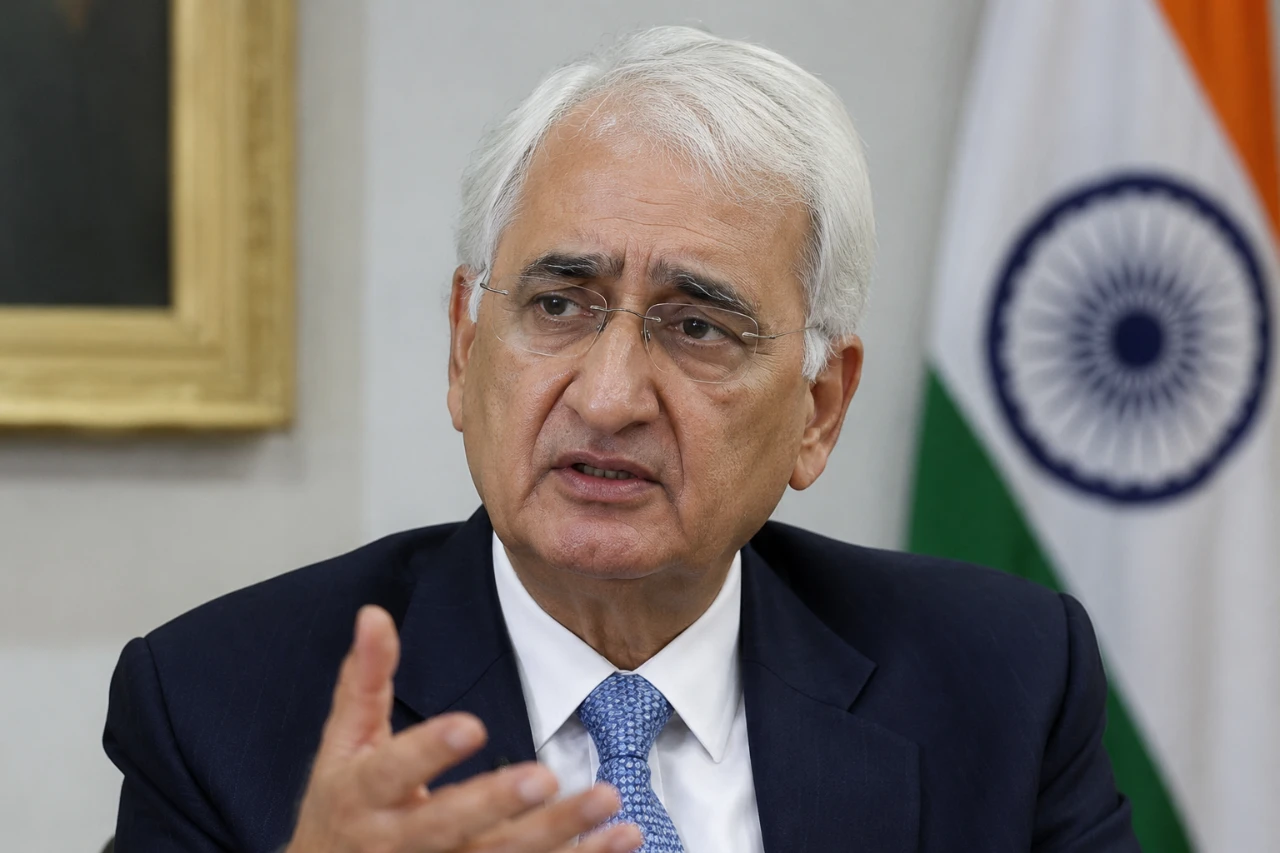
Salman Khurshid Congress Senior Leader (image source: "Chat GPT AI Generated Visuals")
Our Daily Dose of Truth and Trends
Salman Khurshid Congress Senior Leader (image source: "Chat GPT AI Generated Visuals")
Commenting on the political situation in Uttar Pradesh, former Union Minister and senior Congress leader Salman Khurshid recently stated that strong coordination between the Congress and the Samajwadi Party (SP) could significantly impact the state’s politics. His remarks have once again drawn attention to opposition strategies ahead of future elections.
Due to its population and parliamentary representation, Uttar Pradesh remains one of India’s most crucial political states. The entire nation often keeps a close watch on any major alliance or political alignment within the state, as it has a profound impact on electoral outcomes.
According to Khurshid, cooperation among opposition parties could strengthen their collective presence in constituencies where the splitting of votes has historically benefited rival parties. His statement reflects the ongoing discourse within Indian politics regarding opposition unity and the formation of alliances.
The Congress and the SP have collaborated in the past during different political phases, although election outcomes and strategies have varied. Political analysts believe that the success of an alliance depends not only on seat-sharing but also on organizational synergy and the ability to mobilize voters.
Proponents of opposition cooperation argue that combining regional influence with a national-level campaign could enhance competitiveness in Uttar Pradesh. They believe that political partnerships can help consolidate support across diverse social and demographic groups.
On the other hand, critics argue that an alliance alone does not guarantee an election victory. They point out that the leadership’s message, candidate selection, local issues, and the organization at the grassroots level are equally important factors.
Political analysts believe that Uttar Pradesh has become a crucial testing ground for coalition politics, where parties frequently form strategic partnerships to improve their electoral outcomes. Political developments in the state often influence political discourse at the national level.
Recent political events across India demonstrate that forming coalitions remains a vital strategy for both regional and national parties. Leaders constantly assess whether broader partnerships can yield better electoral results.
Salman Khurshid’s statements have sparked a debate in political circles regarding the future direction of opposition politics. Questions are being raised about how alliances will be formed and whether the parties will be able to sustain their cooperation in the long run.
Meanwhile, supporters of both the Congress and the SP view this collaborative political approach as an opportunity to expand their reach among voters and strengthen their organizations. Political analysts are assessing the potential scenarios, while public reaction remains mixed.
The ongoing debate surrounding alliances reflects a significant shift in Indian politics, where regional influence and coalition strategies are shaping the electoral landscape. Political parties across the country are rapidly considering flexible approaches to remain competitive.
While it remains uncertain whether such partnerships will ultimately alter the political equation in Uttar Pradesh, the discussion has refocused attention on opposition strategy, coalition politics, and future electoral arithmetic in one of India’s most influential states.