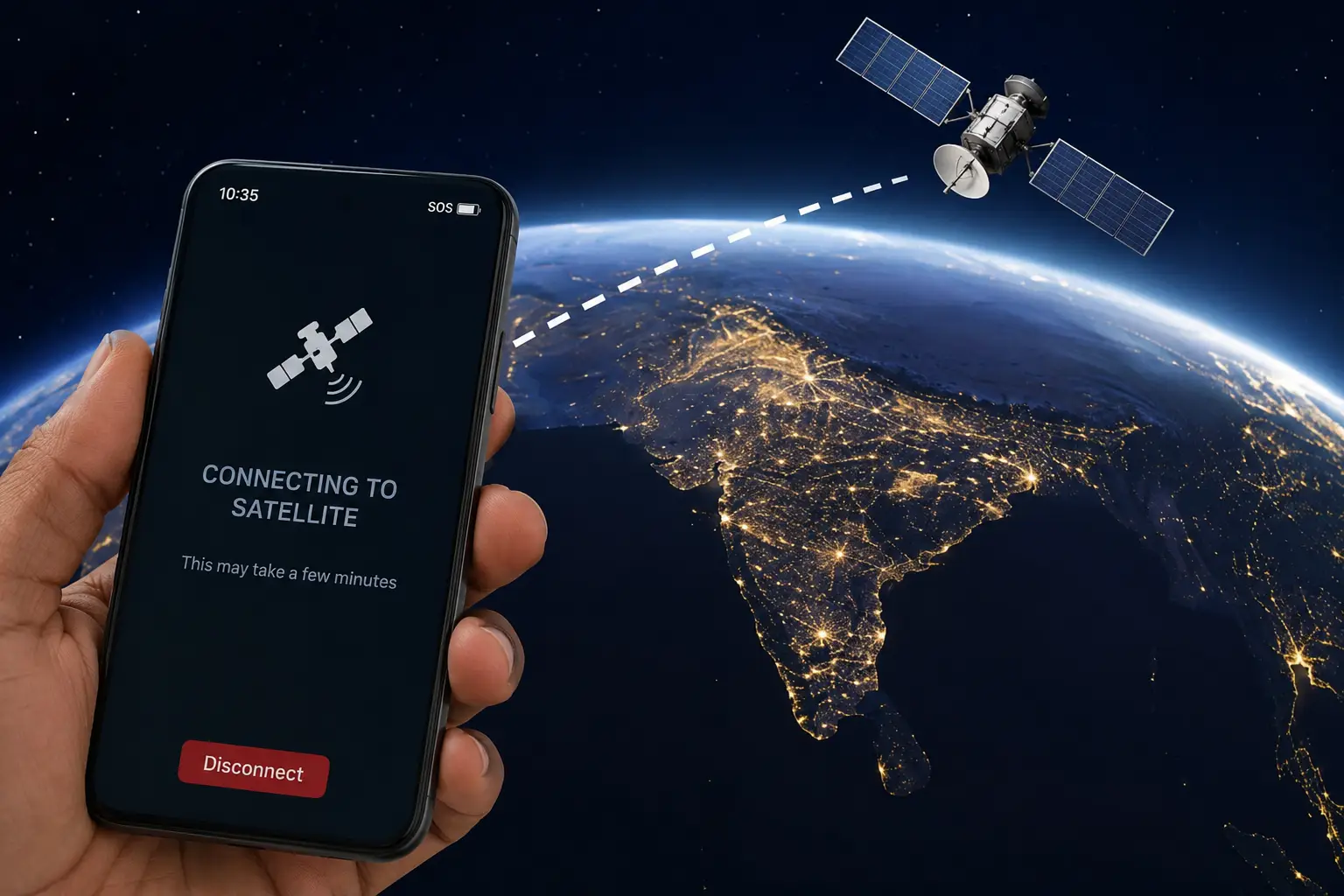
Smartphones in India Could Soon Gain Satellite Connectivity, Though Apple and Google Are Reportedly Concerned About Technical and Regulatory Challenges (image Sourec: Chat GPT, "AI Visuals")
Our Daily Dose of Truth and Trends
Smartphones in India Could Soon Gain Satellite Connectivity, Though Apple and Google Are Reportedly Concerned About Technical and Regulatory Challenges (image Sourec: Chat GPT, "AI Visuals")
India may soon witness a major transformation in the field of mobile communication, as satellite-based smartphone connectivity draws closer to becoming a reality. This technology could enable users to send messages, access emergency services, and stay connected even in remote areas where traditional mobile networks are unavailable. However, major tech companies like Apple and Google are reportedly quite cautious regarding the various technical and legal challenges associated with launching this technology.
Satellite connectivity in smartphones is being hailed as one of the next major advancements in the telecom industry. Unlike traditional mobile networks, which rely on cell towers, this technology connects the phone directly to satellites orbiting the Earth. This technology could prove immensely useful in rural areas, forests, mountains, deserts, and disaster-stricken regions, where mobile signals are often weak or entirely absent.
Several telecom and space technology companies are currently exploring potential partnerships to introduce satellite communication services in India. Industry experts believe that this technology can enhance emergency response systems—particularly during floods, earthquakes, cyclones, and other natural disasters—when conventional communication infrastructure is prone to failure.
India’s rapidly expanding digital economy, coupled with its vast base of smartphone users, makes it one of the most attractive markets for satellite communication services. With millions of users residing in remote villages and challenging terrains, satellite-based connectivity can play a pivotal role in bridging the digital divide across the country.
However, reports suggest that companies like Apple and Google remain concerned regarding the practical application of this technology. A major challenge lies in hardware-related limitations, as smartphones may require specialized antennas, advanced chips, and additional power management systems to support stable satellite communication.
Another concern is the substantial cost involved in maintaining satellite infrastructure and networks. Building and operating satellite communication systems requires massive investment, and companies may face difficulties in providing affordable services to customers while simultaneously maintaining profitability.
In India, regulatory approvals and spectrum allocation remain key issues. Telecom operators, government agencies, and technology companies are still deliberating on how to integrate satellite communication services into the country’s existing telecom infrastructure to avoid any conflicts with traditional mobile networks.
Industry experts suggest that battery consumption could emerge as another major concern. Direct satellite communication typically requires more robust signal transmission compared to standard mobile networks; if not properly optimized, this could adversely impact smartphone battery life.
Concerns regarding security and privacy are also being closely scrutinized. Since satellite communication operates differently from standard telecom infrastructure, companies must ensure secure encryption, user authentication, and protection against cyber threats.
Despite these challenges, the future prospects for satellite-enabled smartphones are immense. Technology companies believe that this feature could eventually become a standard feature in premium smartphones, particularly for emergency communication and connectivity in remote areas.
Global competition in satellite internet and communication services is also intensifying rapidly. Companies worldwide are making massive investments in Low Earth Orbit (LEO) satellite networks, designed to deliver faster and more reliable global coverage. It is expected that India will become a key player in this emerging market in the coming years.
If successfully implemented, satellite smartphone connectivity could completely transform the way people stay connected in remote and underserved regions. While companies like Apple and Google are still assessing the risks and technical hurdles involved, this technology is steadily drawing closer to becoming a reality for millions of Indian users.
India is actively working on satellite connectivity for smartphones, as the country aims to improve communication access in remote and underserved regions. Large parts of India—including hilly terrains, forests, deserts, and border areas—still face the problem of weak or unreliable mobile network coverage. Satellite-enabled smartphones can help bridge this gap, allowing users to stay connected even without traditional mobile towers.
This technology is also being viewed as a significant step toward strengthening emergency communication systems. During floods, earthquakes, cyclones, or other natural disasters, regular telecommunication networks often cease to function. In such emergency situations, satellite connectivity can provide a backup communication facility for rescue teams, government agencies, and citizens.
India’s growing digital economy is another driving force behind this initiative. With millions of smartphone users relying on internet-based services, authorities and telecom companies are actively seeking modern technologies capable of providing nationwide connectivity, unconstrained by geographical boundaries.
Satellite communication also holds the potential to benefit sectors such as defense, transportation, shipping, aviation, agriculture, and tourism. Farmers residing in remote villages, travelers venturing into secluded areas, and individuals working in challenging terrains could all gain access to more reliable communication services.
Furthermore, this move is expected to strengthen India’s position in the global space and telecommunications industry. As countries around the world race to expand satellite internet and communication networks, India aims to ensure that it remains an integral part of the next major technological shift in mobile connectivity.